
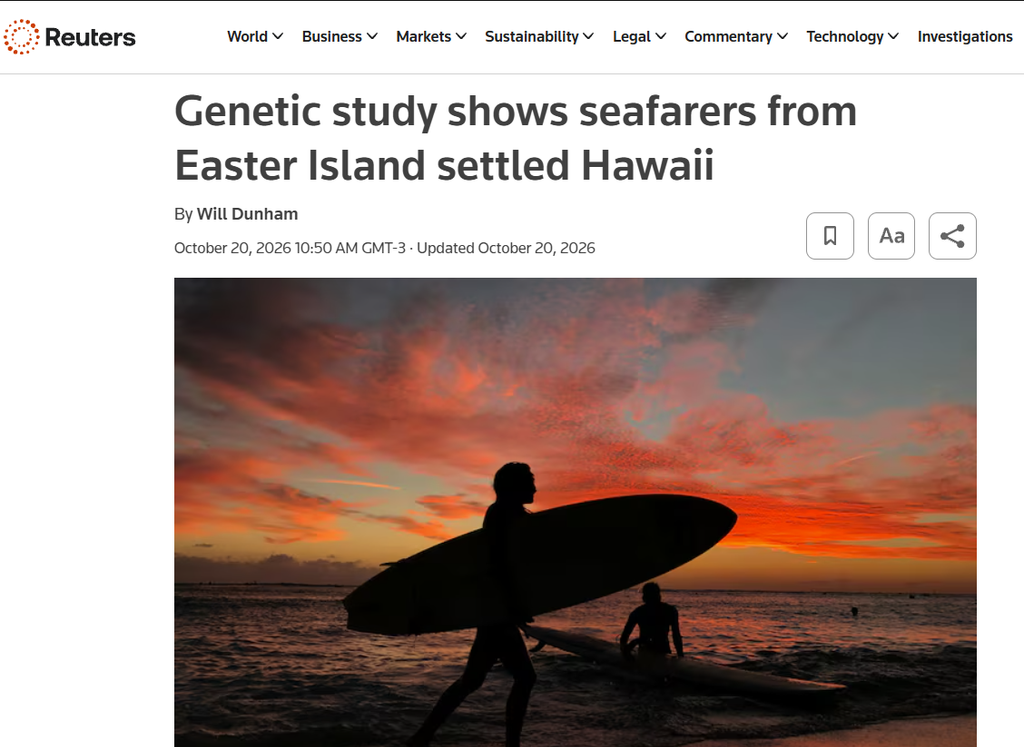
In recent days, dozens of international media outlets and news agencies have shared a headline as eye-catching as it is inaccurate: «Easter Island’s navigators settled Hawaiʻi». Although the temptation to simplify the great voyages of the Pacific into a single catchy line is strong, the scientific reality described in the study that sparked the news is far more fascinating, complex, and nuanced than viral headlines suggest.
Published on October 8, 2026, in the prestigious journal Science (and selected to illustrate its official cover), the article entitled «Message in a bottleneck: Nested founder effects from French Polynesia to Rapa Nui (Easter Island) and Hawaiʻi» has brought to the table one of the most significant genomic analyses of recent years.
However, what exactly does the research led by geneticists from Stanford and UC San Diego say? And more importantly: where is the line between the sensationalist interpretation of the press and methodological caution? We break down the real data to separate myths from genomic evidence.
What does the Science study really reveal about Rapa Nui and Hawaiʻi?
Led by researchers from Stanford University and UC San Diego—with prominent Chilean participation through Professor Mauricio Moraga from the University of Chile—the study analyzed whole-genome sequences from 1,050 individuals across Polynesia.
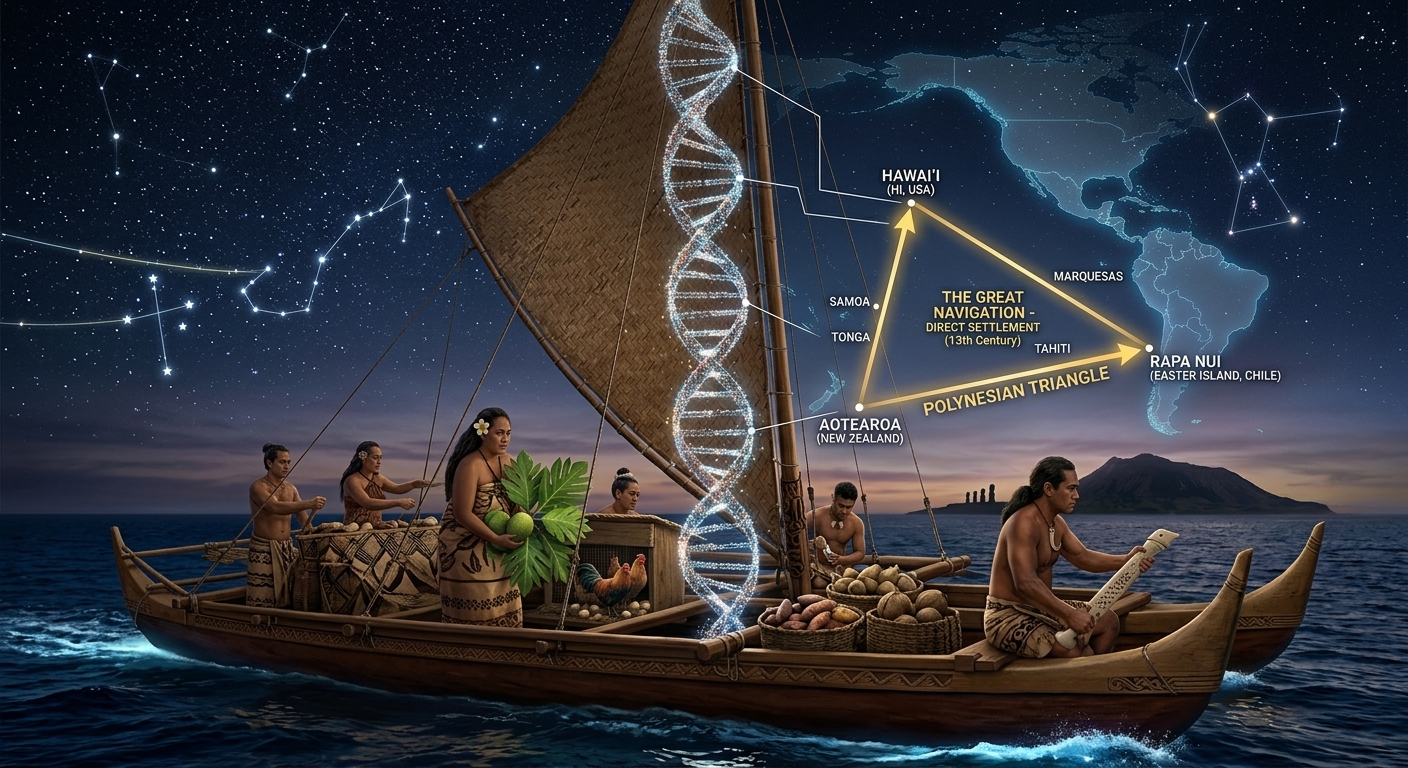
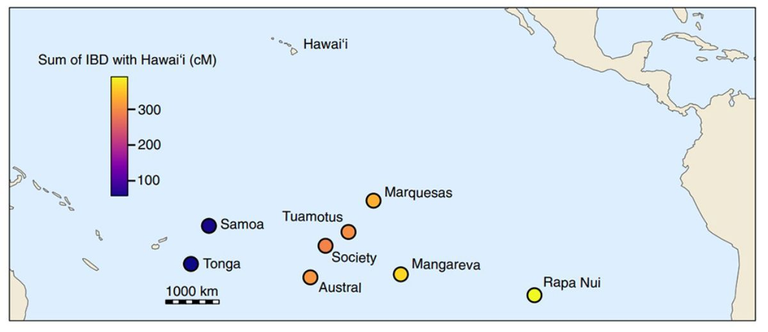
The graphical and statistical results of the paper show that Rapa Nui and Hawaiʻi are two of the most connected and genetically related populations within the region, even surpassing the proximity to the Marquesas Islands. This close bond suggests the existence of an ultra-navigation culture (Holomoana Nui) capable of populating the most distant extremes of the Pacific.
The phenomenon of genetic bottlenecks and the “Russian doll”
Beyond geography, the core of the Science study is biomedical. The authors discovered that Polynesia experienced cumulative founder effects up to ten times more intense than those recorded in classical European populations such as Finns or the Amish.
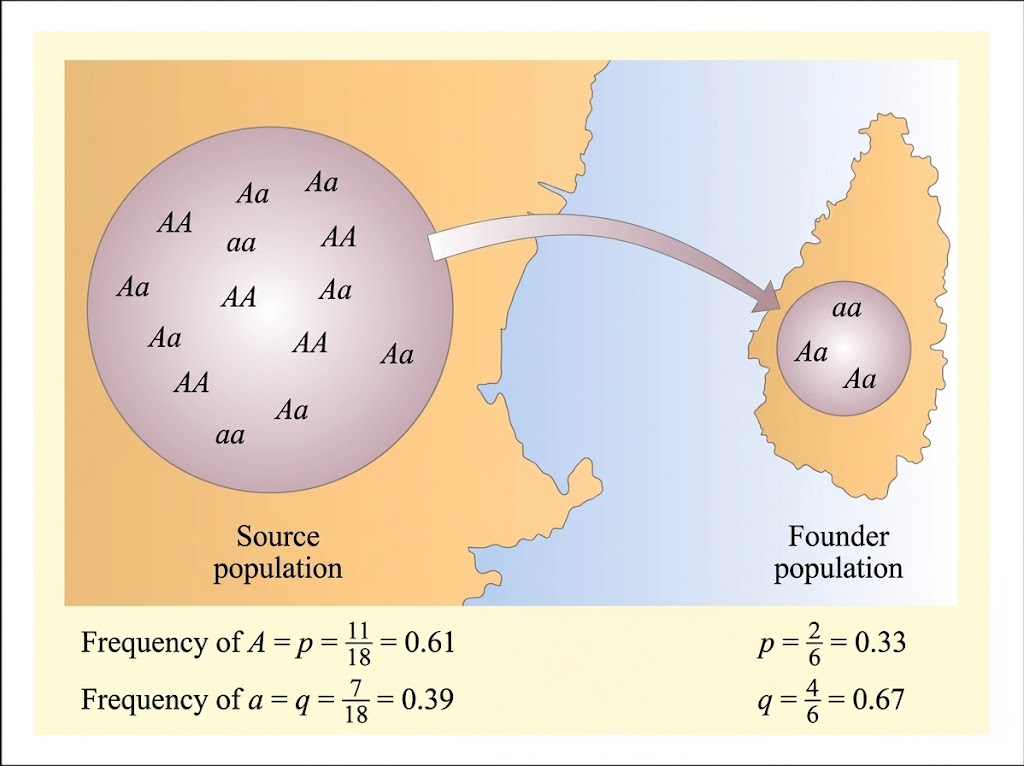
Each colonized island functioned as a successive filter (a genetic “Russian doll” effect) that reduced initial diversity and amplified rare mutations. This made it possible to identify critical clinical variants in Eastern Polynesia that are completely absent (0%) in major global databases like gnomAD, such as:
- The FAN1 gene (p.Trp707): Frequent in Polynesia and linked to severe renal failure (karyomegalic interstitial nephritis).
- The ADAMTSL4 gene (p.Arg746His): Related to early lens dislocation.
- The PDE6B gene (p.Ala733Pro): Associated with progressive vision loss.
This is where the mainstream media fell into the error of simplifying the news. While Science data shows undeniable genetic kinship and shared ancestral roots extending as far as Mangareva, Professor Mauricio Moraga clarifies a fundamental methodological boundary:
«Populations from both islands share DNA segments inherited from common ancestors. The interpretation proposed is that their founders belonged to a closely related ancestral population from which groups departed toward distant destinations. Genetics supports that shared origin, although it does not allow us to reconstruct specific expeditions nor assert categorically that the exact same physical individuals set foot on both islands.»
In other words, the idea that the Rapa Nui directly “settled” Hawaiʻi is, to this day, a speculation by the study’s authors, not a historical fact proven by genetics.
Despite debunking the bias of simplistic headlines, the Science study pays homage to one of the most impressive maritime capabilities in human history. The authors highlight the existence of an oceanic ultra-navigation culture called Holomoana Nui (“grand oceanic navigation”).
7,000 kilometers across open sea: Rapa Nui’s greatest odyssey
In the mid-13th century, an intrepid group of navigators ventured into the North Pacific aboard gigantic double-hulled canoes, known in the seafaring tradition as Vaka Ama. Overcoming a journey of more than 4,400 miles (around 7,000 kilometers) in open water without losing their way was neither a random accident nor the result of drifting vessels.
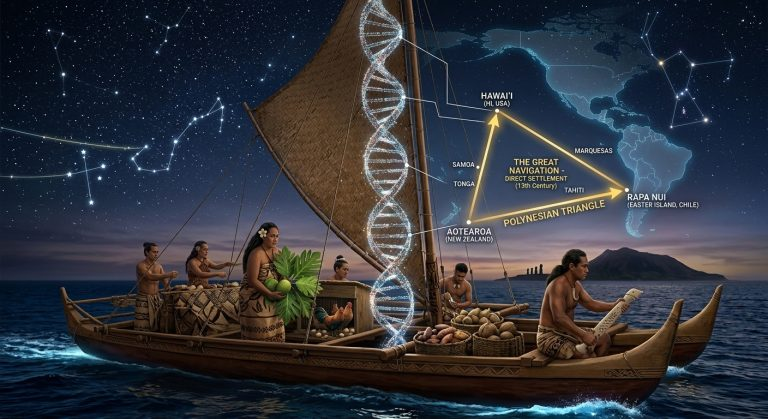
Guiding themselves with millimeter precision through an ancestral system of reading the stars, ocean currents, bird behavior, and clouds, this milestone makes Pacific explorers the greatest community of navigators in human history, far surpassing European expeditions that would occur centuries later in distance and technical skill.
Towards fair and preventive precision medicine
Beyond anthropology, the study insists that including Pacific Island populations (NHPI) in genomic research is not just a matter of scientific rigor, but of strict equity and justice in public health.
While populations like the Amish or Finns have had standardized preventive screening programs for decades, Native Hawaiians and other islanders lack clinical guidelines to detect these founder mutations. Knowing these allele frequencies opens the door to a new era of preventive medicine tailored to the real needs of Pacific communities.

Debunking: Why did the international press and Reuters misinterpret the study?
In recent weeks, the publication of the genomic study in the journal Science (Shanks et al., 2026) triggered a wave of identical headlines in mass media and news portals everywhere. Networks, outlets, and news portals released publications categorically claiming things like: «First inhabitants of Hawaiʻi arrived by canoe from Rapa Nui» or «Study reveals Rapa Nui people were founders of Hawaiʻi after an epic voyage».
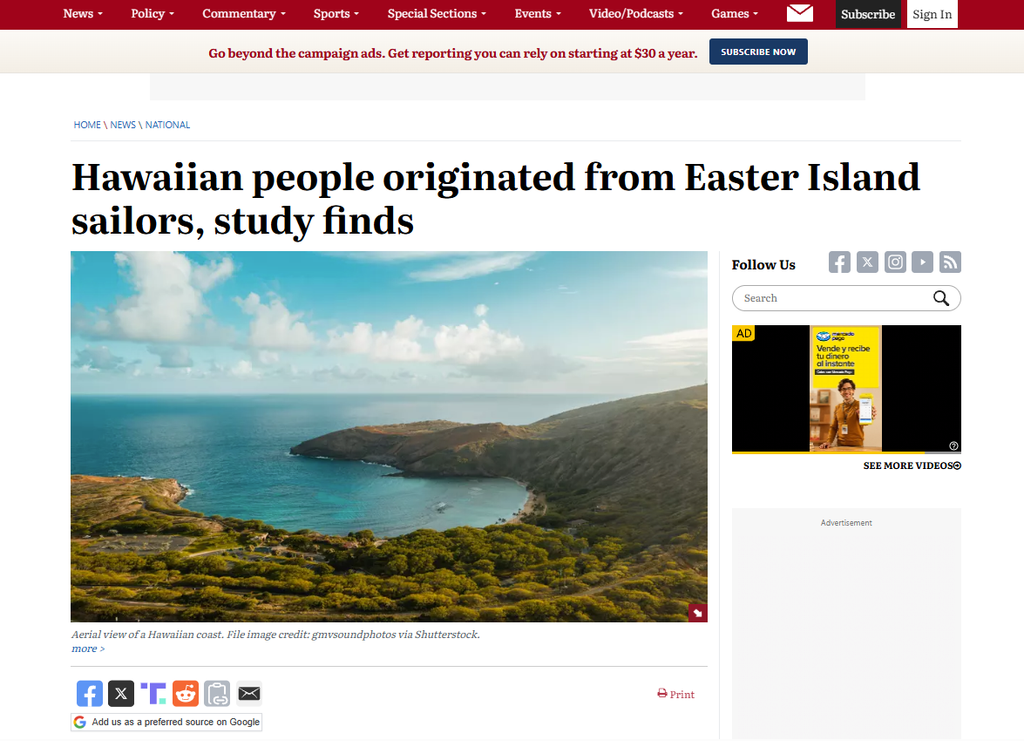
Although the idea of a great nautical odyssey is extremely attractive to the audience, this coverage fell into a widespread journalistic vice: sensationalism and the extreme simplification of science.
Sensationalist headlines vs. Science‘s genomic reality
To dismantle the inaccurate information circulating online and clarify what the media omitted in their quest for clicks, we contrast myths with hard data from the official paper:
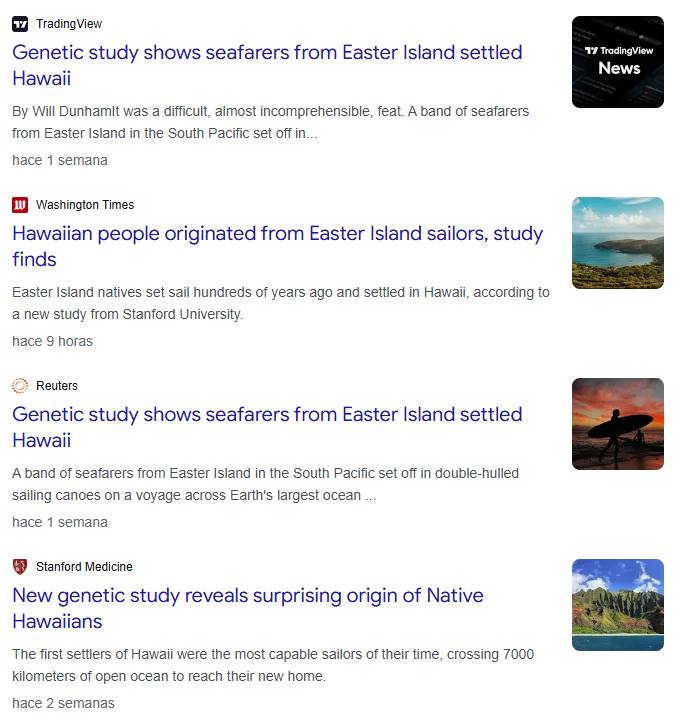
- Media Myth (e.g., «Rapa Nui settled Hawaiʻi by canoe»): The media takes for granted that a direct navigation route and a documented physical journey from Rapa Nui to the North Pacific were discovered.
The Reality: The Science study does not track travel logs or individual physical expeditions. What genomics analyzes are shared DNA segments and population bottlenecks. The extremely high genetic closeness between both islands is due to sharing ancestral roots and a common lineage within Eastern Polynesia (with Mangareva as a deep origin), but a direct and exclusive colonization from Rapa Nui to Hawaiʻi remains solely a speculative hypothesis posed by the authors, not an empirical proven fact.
- Media Myth (e.g., «Rapa Nui people were the sole founders»): Rapa Nui is presented as the isolated starting point responsible for Hawaiian settlement.
The Reality: The DNA-based family tree places Hawaiʻi and Rapa Nui as closely connected extreme points, but their structure is anchored to complex regional networks that include the Marquesas Islands and Mangareva, coinciding with dispersion and historical models already described by anthropology and linguistics decades ago.
What the press completely ignored: While portals competed for the most epic headline about canoes, they overlooked the true milestone and the study’s greatest contribution: biomedicine. Science‘s major discovery is the identification of critical genetic mutations (such as the FAN1 gene, linked to severe renal failure) that have a high frequency in the Polynesian population but are totally absent (0%) in major global databases like gnomAD, exposing the urgency of creating preventive health programs for islanders.
Download the official Science study
For readers, researchers, and professionals who wish to delve into the methodological data, DNA analyses, and complete graphs of this research, we make available the original document published in the journal Science:
👉 Download the Official Study in PDF – Shanks et al., 2026
Conclusion: Beyond the headline, the true science of the Pacific
Global fascination with the history of Rapa Nui and Hawaiʻi shows that the mysteries of the Pacific Ocean continue to captivate humanity. However, faced with the sensationalism of fast headlines seeking to simplify history into a simple canoe route, science invites us to look much higher and with greater depth.
The Science study not only redraws the map of an ancestral ultra-navigation network as complex as that of the Holomoana Nui culture, but it leaves us with a fundamental reminder: the true revolution of modern genomics is not in fabricating myths about the past, but in healing the future. Deciphering the bottlenecks and hidden mutations of Pacific peoples is an act of strict sanitary justice and medical equity.
In the end, the true feat of Polynesian navigators does not lie in a linear destination, but in their incredible capacity to connect the most distant points of the planet and leave us a genetic, cultural, and human heritage that today, thanks to rigorous science, we begin to understand in its fair and marvelous dimension.